

Why Buying a Workstation Costs More Than You Think (3-Year Math for Arch-Viz)
The number on the build sheet is the smallest part of what a workstation costs you. People compare a cloud GPU’s hourly rate to “the computer I already paid for” and feel like the cloud is the expensive one. Stretch the comparison across three years, the realistic life of a render machine, and the picture flips, because owning carries a stack of costs that never appear on the original invoice.
This is not an argument against owning. Plenty of architects should own. It is an argument for counting fully, so the decision is made on the real total rather than the sticker price.
The costs the build sheet leaves out
A render-grade workstation starts at a few thousand for the machine, and that is where most people stop adding. The parts that follow are the ones that quietly inflate the real figure. The graphics card you bought will feel slow within a couple of years as software and scene sizes grow, so a mid-life GPU upgrade is realistic, not pessimistic. The machine draws serious power while rendering, every hour, which lands on an electricity bill you rarely attribute to it. It loses resale value steadily, so depreciation is a real cost even if you never sell. And every hour it sits locked during a render, or idle between projects, is capacity you paid for and did not use.
A realistic three-year breakdown
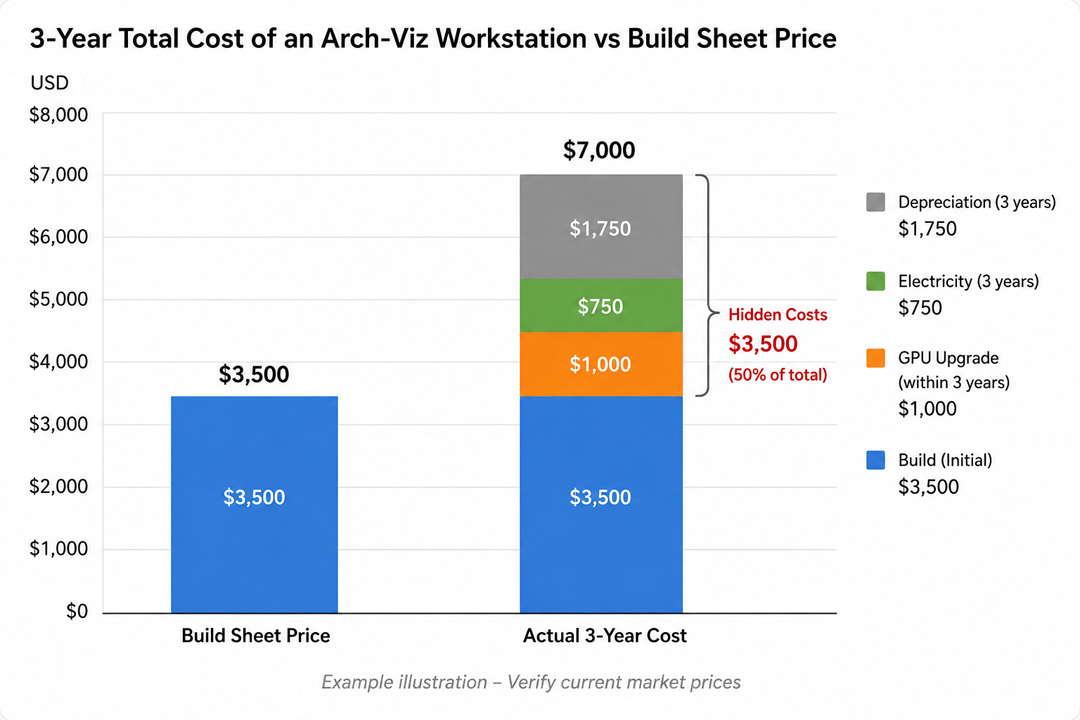
Here is an illustrative total cost of ownership for a single arch-viz workstation over three years. The exact figures depend on your hardware choices and local power prices, so treat these as a shape rather than a quote, and check current prices before you rely on them.
| Cost over 3 years | Illustrative amount | Why it counts |
|---|---|---|
| The workstation build | ~$3,000 | The number everyone budgets for |
| Mid-life GPU upgrade (year 2) | ~$1,200 | To keep pace with heavier scenes and software |
| Electricity under render load | ~$400 to $700 | Sustained power draw over many render hours |
| Depreciation / lost resale value | ~$1,000+ | Hardware value falls whether or not you sell |
| Downtime and idle capacity | Hard to price, real | Hours locked rendering or sitting unused between jobs |
The build sheet said three thousand. The real three-year cost is closer to six. That gap is the whole point of this article, and it is the number that should sit next to a cloud rendering bill, not the standalone price of the box.
How renting compares over the same three years
Put a cloud GPU next to that. At an illustrative eight to nine dollars an hour, six thousand dollars buys somewhere around 650 to 750 hours of a dedicated RTX 4090. The question that decides everything is how many render hours you actually use in three years. If you render heavy scenes most working days, you will burn through that and more, and owning wins clearly. If your heavy rendering comes in bursts around deadlines, totalling well under that figure over three years, renting costs less and you never touch the upgrade, the electricity or the depreciation. The clean version of that buy-versus-rent comparison is in render farm vs new workstation, and the itemized reasons cloud feels pricey are in why cloud rendering feels expensive.
When owning still makes sense
To keep this balanced, owning is the right call in real situations. If you render heavy work daily, the hours add up fast enough that a workstation amortizes well below the rental equivalent. If you need guaranteed, instant access without depending on a connection or a provider, your own machine delivers that. And if you value working entirely offline, owning is the only answer. The trap is not owning. The trap is comparing the sticker price of owning to the full price of renting, which stacks the deck. Compare full cost to full cost and the decision becomes clear.
If you decide to rent the heavy hours
If your three-year math points toward renting the spikes rather than owning the average, the route depends on your renderer, as always. Offline engines like V-Ray or Corona can go to a per-frame SaaS farm with predictable cost and no idle risk. Real-time apps like Lumion need a per-hour machine, since those farms cannot run them. iRender is the per-hour service I reach for, with a dedicated RTX 4090, Credit Back on each session and a free trial to ground your own numbers. The cost to watch is idle time, the meter running after a render finishes, so the shutdown habit is what keeps renting cheaper than owning in practice.
Before you spend three thousand on a box that will really cost six, price the rental side. iRender bills per hour for a dedicated RTX 4090, with Credit Back and a free trial to test your own workload. Compare renting on iRender
FAQ
- How much does an arch-viz workstation really cost over three years?
More than the build sheet, often close to double. A roughly $3,000 machine typically picks up a mid-life GPU upgrade of around $1,200, several hundred dollars of electricity under render load, over a thousand in lost resale value, and the unpriced cost of hours spent locked or idle. That brings a realistic three-year total into the high $5,000s, against a sticker price that looked like $3,000. Local hardware prices vary, so check current figures, but the hidden half is consistent.
2. Is it cheaper to buy a workstation or rent cloud rendering?
It comes down to how many render hours you use. Six thousand dollars, the realistic three-year cost of owning, buys roughly 650 to 750 hours of a dedicated cloud RTX 4090 at eight to nine dollars an hour. If you render heavy scenes most days you will exceed that, and owning wins. If your heavy rendering is bursty and totals well under that over three years, renting costs less and avoids the upgrade, electricity and depreciation entirely.
3. Why is electricity a real cost of owning a render machine?
Because rendering pulls serious, sustained power. A render-grade machine under full load draws far more than idle desktop use, and an architect who renders regularly accumulates many hours of that draw over a year. Spread across three years it adds several hundred dollars that rarely gets attributed to the workstation, since it hides inside the general electricity bill. It is a genuine cost of ownership that a cloud rate already includes in its price.
4. When does buying a workstation make more sense than renting?
When you render heavy scenes most working days, so the hours amortize the hardware below what renting the same time would cost. Also when you need guaranteed instant access without depending on a connection or provider, or when you work entirely offline. The key is comparing the full three-year cost of owning to the full cost of renting, rather than the workstation’s sticker price to the cloud’s hourly rate, which makes owning look cheaper than it is.
Related post: The Surprise Cloud Render Bill: Why You Got Charged for an Idle Machine