

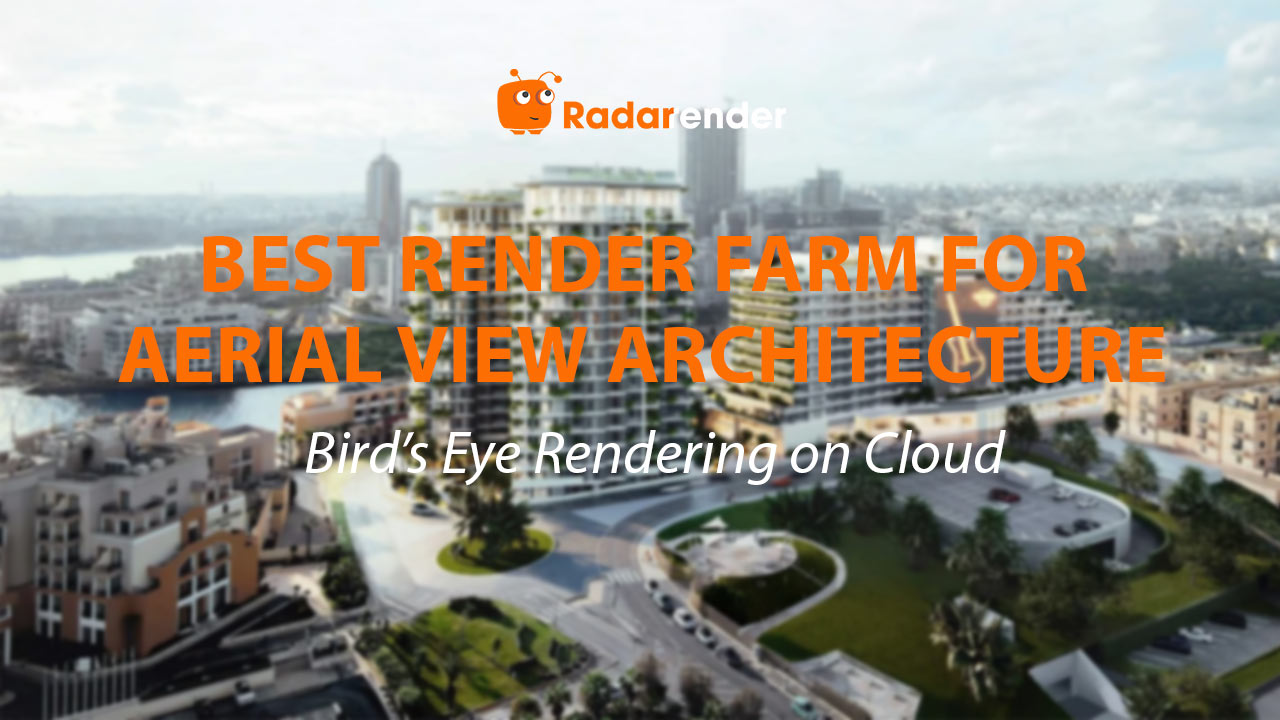
Best Render Farm for Aerial View Architecture: Bird’s Eye Rendering on Cloud
Aerial architectural views are the most VRAM-intensive render type — the camera sees the entire project simultaneously (buildings, terrain, vegetation, roads, context), loading all geometry into GPU memory at once. On iRender’s RTX 4090 (24GB VRAM, ~$8.20/hour), a 4K aerial costs approximately $2.05–4.10 with Lumion (15–30 min), $0.70–1.40 with Enscape (5–10 min), or $4.10–8.20 with V-Ray GPU (30–60 min). Local GPUs with 8–12GB VRAM (RTX 3060, GTX 1070) frequently crash on aerial renders because the full-scene view exhausts VRAM that eye-level views don’t trigger. The RTX 4090’s 24GB VRAM is the minimum recommended for complex aerial architectural renders at 4K.
| Aerial Scene Scale | Lumion (RTX 4090) | Enscape (RTX 4090) | V-Ray GPU (RTX 4090) | VRAM Usage |
|---|---|---|---|---|
| Single building + site | 10–18 min / $1.40–2.45 | 3–6 min / $0.40–0.80 | 20–40 min / $2.70–5.50 | 10–16GB |
| Multi-building development | 15–25 min / $2.05–3.40 | 5–8 min / $0.70–1.10 | 30–50 min / $4.10–6.80 | 14–20GB |
| Masterplan aerial | 20–35 min / $2.70–4.80 | 6–10 min / $0.80–1.40 | 40–70 min / $5.50–9.50 | 18–24GB |
| City-scale bird’s eye | 25–45 min / $3.40–6.15 | 8–15 min / $1.10–2.05 | 50–90 min / $6.80–12.30 | 20–24GB+ |
Why Do Aerial Views Consume More VRAM Than Eye-Level Renders?
At eye level, the camera sees a limited slice of the scene — buildings behind the camera aren’t rendered, distant objects use low-detail LODs, and most vegetation is out of frame. At aerial altitude, the camera sees everything simultaneously: every building, every tree, every road, the entire terrain mesh. The GPU must load all geometry into VRAM at once. A Lumion masterplan that uses 12GB VRAM at eye level can consume 20–22GB at aerial view — a 70–80% increase from the same scene.
The practical solution for scenes exceeding 24GB: switch to “High” quality instead of “Ultra” in Lumion/Twinmotion — this reduces vegetation detail at distance, cutting VRAM usage by 20–30%. For V-Ray, use proxy objects and LOD for distant buildings to stay within the RTX 4090’s VRAM ceiling.
Which Tool Produces the Best Aerial Renders on Cloud?
Lumion leads for aerial views — its atmospheric sky system, volumetric clouds, and vegetation viewed from above create the most visually compelling aerial perspectives among real-time tools. Lumion’s OpenStreetMap import adds instant context (surrounding streets, existing buildings) that makes aerial views look realistic without manual modeling. V-Ray with 3ds Max produces the highest quality aerials but requires manual environment setup and costs 2–3× more per image.
For planning submission aerials where context accuracy matters more than visual beauty, Enscape at $0.40–1.40 per image is the most cost-effective choice — simple, fast, and accurate to the BIM model.
See more: Render aerial arch-viz on cloud GPU → View aerial rendering servers on iRender
Frequently Asked Questions
- How much does a complete aerial presentation set cost on cloud?
A typical aerial set — 3 bird’s-eye angles + 1 axonometric + 2 drone-level perspectives = 6 images — costs approximately $12–25 with Lumion on iRender, $4–8 with Enscape, or $25–55 with V-Ray GPU. For developer marketing: Lumion aerials are the standard quality level. For competition entries and magazine submissions: V-Ray aerials are preferred by juries and editors.
2. Can I add Google Earth context to aerial renders on cloud?
Not directly from Google Earth (license restrictions). Lumion imports OpenStreetMap data as 3D context — buildings, streets, and terrain generated from open-source mapping data. This provides accurate urban context for aerial views without copyright issues. For more detailed context, import satellite imagery as a ground plane texture in 3ds Max or SketchUp before bringing the model to the rendering application on iRender.
3. Should aerial renders be 4K or higher resolution?
4K (3840×2160) for most presentations and digital use. For large-format prints (A1 panels, exhibition boards) commonly used in planning submissions and competition displays, render at 6K (5760×3240) — on iRender’s RTX 4090, 6K takes approximately 2–3× longer than 4K. A 6K Lumion aerial costs approximately $4.10–7.20 (30–50 min) vs $2.05–4.10 at 4K. The extra resolution ensures sharp detail when viewers examine aerial perspectives at close range.
Related post: Best Render Farm for Landscape Architecture: Large Outdoor Scenes on Cloud