

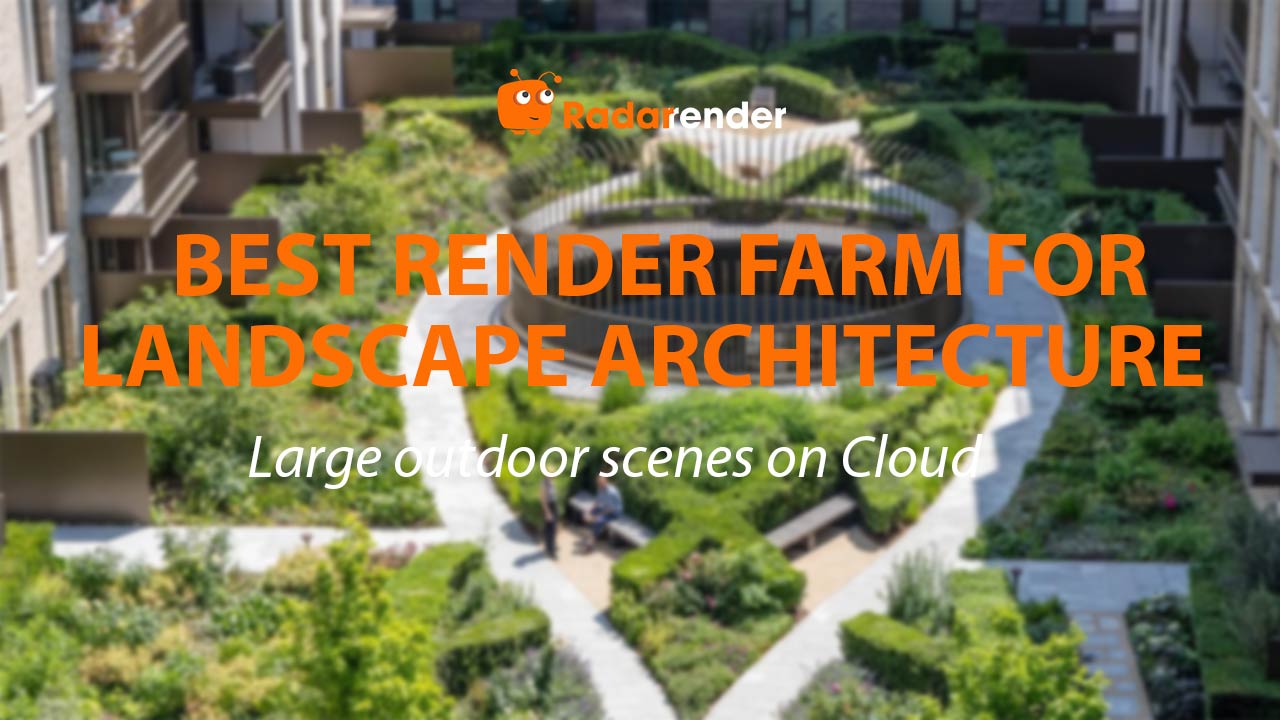
Best Render Farm for Landscape Architecture: Large Outdoor Scenes on Cloud
Landscape architecture is the most VRAM-demanding arch-viz niche — dense vegetation, terrain, water features, and atmospheric effects routinely consume 18–24GB VRAM at 4K, exceeding most local GPUs. On iRender’s RTX 4090 (24GB VRAM, 256GB RAM, ~$8.20/hour), Lumion is the top choice for landscape architects: its industry-leading vegetation library includes 10,000+ objects with 1,800+ plant species. A 4K landscape still renders in 10–18 minutes ($1.40–2.45). For publication-quality landscape renders, V-Ray with 3ds Max + Forest Pack on RebusFarm produces photorealistic results — though at 3–5× higher cost. Twinmotion and D5 Render (both free) offer budget alternatives at $0.70–1.40 per image.
| Landscape Tool | Vegetation Library | 4K Still (RTX 4090) | Cost/Image | Best For |
|---|---|---|---|---|
| Lumion ⭐ | 10,000+ (1,800+ plants) | 10–18 min | $1.40–2.45 | Best vegetation quality |
| V-Ray + Forest Pack | Unlimited (procedural) | 25–60 min | $3.40–8.20 | Publication accuracy |
| Twinmotion (free) | ~3,000+ objects | 5–12 min | $0.70–1.65 | Budget, Path Tracer |
| D5 Render (free) | ~5,000+ objects | 5–12 min | $0.70–1.65 | Budget, Live Sync |
| Enscape | Smaller built-in library | 4–8 min | $0.55–1.10 | Speed, design review |
Why Do Landscape Scenes Push GPU Limits More Than Building Renders?
Three factors make landscapes the heaviest arch-viz workload: (1) Vegetation geometry — a single mature tree in Lumion contains 200,000–500,000 polygons. A park scene with 500 trees generates 100–250 million polygons. (2) Terrain and ground cover — grass systems with millions of individual blades, ground textures with displacement mapping. (3) Water bodies — lakes, streams, and fountains require reflection and refraction calculations adding 20–40% render time.
Local GPUs with 8–12GB VRAM (RTX 3060, GTX 1070) crash or produce visual artifacts on these scenes. The RTX 4090’s 24GB VRAM handles most landscape scenes at “High” quality. For extremely dense masterplan landscapes (10,000+ vegetation objects), reduce quality from “Ultra” to “High” — the visual difference is minimal at presentation viewing distances.
Can You Render Seasonal Variations of the Same Landscape on Cloud?
Lumion’s seasonal vegetation feature lets you switch the same scene between spring, summer, autumn, and winter with one click. Render all four seasons from the same camera angle in approximately 40–72 minutes total ($5.50–9.80) on iRender. This is a powerful presentation technique for demonstrating year-round design impact to planning committees and clients. Twinmotion offers similar seasonal controls but with a smaller plant variety.
For V-Ray + Forest Pack, seasonal variation requires manual material swapping (leaf color, density, ground texture) — more labor-intensive but with full artistic control over each season’s appearance. This workflow is better suited to studios producing high-end seasonal marketing images for resort and hospitality clients.
See more: Render landscape architecture on cloud GPU → Render landscape architecture on cloud GPU → View landscape rendering servers on iRender
Frequently Asked Questions
- How much does a landscape architecture presentation cost on cloud?
A typical package — 3 aerial views + 4 eye-level perspectives + 2-minute flythrough (4K) — costs approximately $15–30 with Lumion on iRender, $8–18 with Twinmotion (free software), or $40–90 with V-Ray on RebusFarm. Most landscape studios budget $20–50 per project. Lumion’s vegetation quality usually justifies its higher per-image cost for landscape-specific work.
2. Is Enscape sufficient for landscape architecture visualization?
For design-phase reviews and quick client presentations, yes — Enscape renders landscape scenes in 4–8 minutes at $0.55–1.10 per image. However, Enscape’s vegetation library is smaller and less detailed than Lumion’s. For marketing-quality landscape renders where plant realism matters (resort proposals, park designs, ecological projects), Lumion or V-Ray produces visibly superior results at the cost of longer render times.
3. Can a local RTX 3060 handle large landscape scenes?
Only for small residential gardens (under 2,000 objects). Park-scale landscapes with 3,000+ trees, dense ground cover, and water features consume 16–22GB VRAM at 4K — far exceeding the RTX 3060’s 12GB. Scenes crash or render with visual artifacts. The RTX 4090’s 24GB VRAM on iRender handles these scenes reliably. Cloud is most valuable for landscape architects specifically because their scenes are the most VRAM-demanding in architecture.
Related post:
Best Render Farm for Architectural Animation: Walkthrough Video on Cloud