

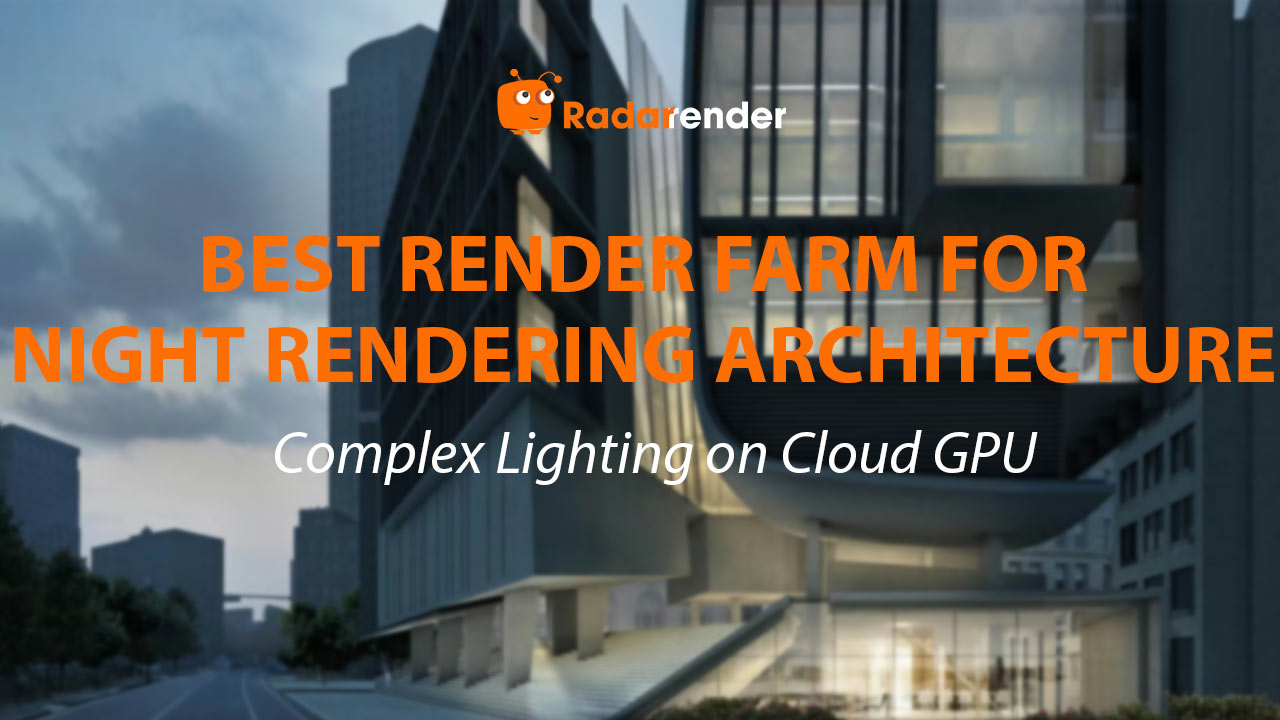
Best Render Farm for Night Rendering Architecture: Complex Lighting on Cloud GPU
Night architectural renders take 50–100% longer than daytime scenes because artificial lighting creates complex multi-source illumination that requires more ray tracing samples to resolve noise. On iRender’s RTX 4090 (~$8.20/hour), a 4K night exterior with V-Ray GPU renders in 25–60 minutes ($3.40–8.20) vs 15–35 minutes ($2.05–4.80) for the same scene in daylight. With Enscape, the difference is smaller: night 4–10 minutes ($0.55–1.40) vs day 3–6 minutes ($0.40–0.80) — Enscape’s real-time engine approximates artificial lighting rather than solving it physically. For publication-quality night renders where light accuracy matters (hotel marketing, retail design), V-Ray or Corona is essential. Corona’s LightMix is particularly powerful for night scenes — render once, then adjust every light individually post-render.
| Night Scene Type | V-Ray GPU (RTX 4090) | Enscape (RTX 4090) | V-Ray Cost | Light Sources |
|---|---|---|---|---|
| Residential exterior (warm) | 20–40 min | 3–7 min | $2.70–5.50 | 5–15 lights |
| Commercial facade (signage) | 25–50 min | 4–8 min | $3.40–6.80 | 10–30 lights |
| Hotel/restaurant (ambient) | 30–60 min | 5–10 min | $4.10–8.20 | 20–50 lights |
| Urban streetscape (complex) | 40–80 min | 6–12 min | $5.50–10.90 | 30–80+ lights |
| Interior night (window glow) | 15–35 min | 3–6 min | $2.05–4.80 | 8–25 lights |
Why Are Night Renders More Expensive Than Day Renders?
Daytime scenes have one dominant light source (the sun) that illuminates everything uniformly — efficient for ray tracing. Night scenes replace the sun with dozens of individual artificial lights — street lamps, interior fixtures, signage, car headlights, landscape uplighting — each casting its own shadows and reflections. The GPU must trace rays from every light source independently, multiplying computation by the number of active lights.
Additionally, night scenes require higher sample counts to resolve noise. Dark areas with subtle lighting gradients (the shadow between two street lamps, reflected window glow on wet pavement) appear noisy at standard sample rates. V-Ray needs approximately 50–100% more samples for clean night renders. The NVIDIA AI Denoiser helps significantly — reducing night render time by 30–40% with minimal quality impact.
How Can Corona LightMix Save Money on Night Renders?
Corona’s LightMix is the most cost-effective feature for architectural night rendering on cloud. Instead of re-rendering the entire scene every time a client says “make the lobby warmer” or “turn off the third-floor lights,” render once with all lights active, then adjust individual light intensity, color temperature, and on/off states in LightMix post-render. One $4–8 Corona render can produce 15–20 lighting variations in seconds — saving approximately $60–160 in re-rendering costs per night scene.
This workflow runs on iRender’s cloud desktop: render Corona, open LightMix in the Corona frame buffer, adjust lights, save each variation. All within the same billable session — no additional render time needed.
See more: Render night architecture on cloud GPU → Render night architecture on cloud GPU → View cloud servers for night rendering on iRender
Frequently Asked Questions
- How much does a night exterior presentation cost on cloud?
A typical night presentation — 3 exterior angles + 2 interior window views + 1 aerial night view = 6 images — costs approximately $15–40 with V-Ray GPU on iRender or $3.50–8.50 with Enscape. Using the AI Denoiser with V-Ray reduces cost to approximately $10–25. For client presentations where lighting mood matters, V-Ray’s accuracy justifies the higher cost — Enscape tends to flatten artificial lighting subtleties.
2. Should I use IES light profiles for night renders on cloud?
Yes — IES profiles from actual luminaire manufacturers (Erco, iGuzzini, Louis Poulsen) produce physically accurate light distribution patterns that make night renders convincing. V-Ray and Corona support IES profiles natively. Loading 30–50 IES lights adds minimal VRAM usage (under 100MB total) but significantly improves realism. On iRender’s RTX 4090, IES profiles add approximately 10–15% render time compared to simplified point/area lights.
3. Is Enscape good enough for night architectural renders?
For design review and client walkthroughs, yes — Enscape produces convincing night atmospheres in 4–10 minutes at $0.55–1.40 per image. For marketing-quality renders where specific light patterns on facades, wet pavement reflections, and color-accurate signage matter, V-Ray or Corona is noticeably superior. Many studios render Enscape night views for internal review ($0.55 each), then produce 2–3 V-Ray hero shots ($3.40–8.20 each) for the final marketing set.
Related post: Best Render Farm for Landscape Architecture: Large Outdoor Scenes on Cloud