

Best Cloud Rendering for AI-Generated Architecture: Stable Diffusion + 3D Pipeline
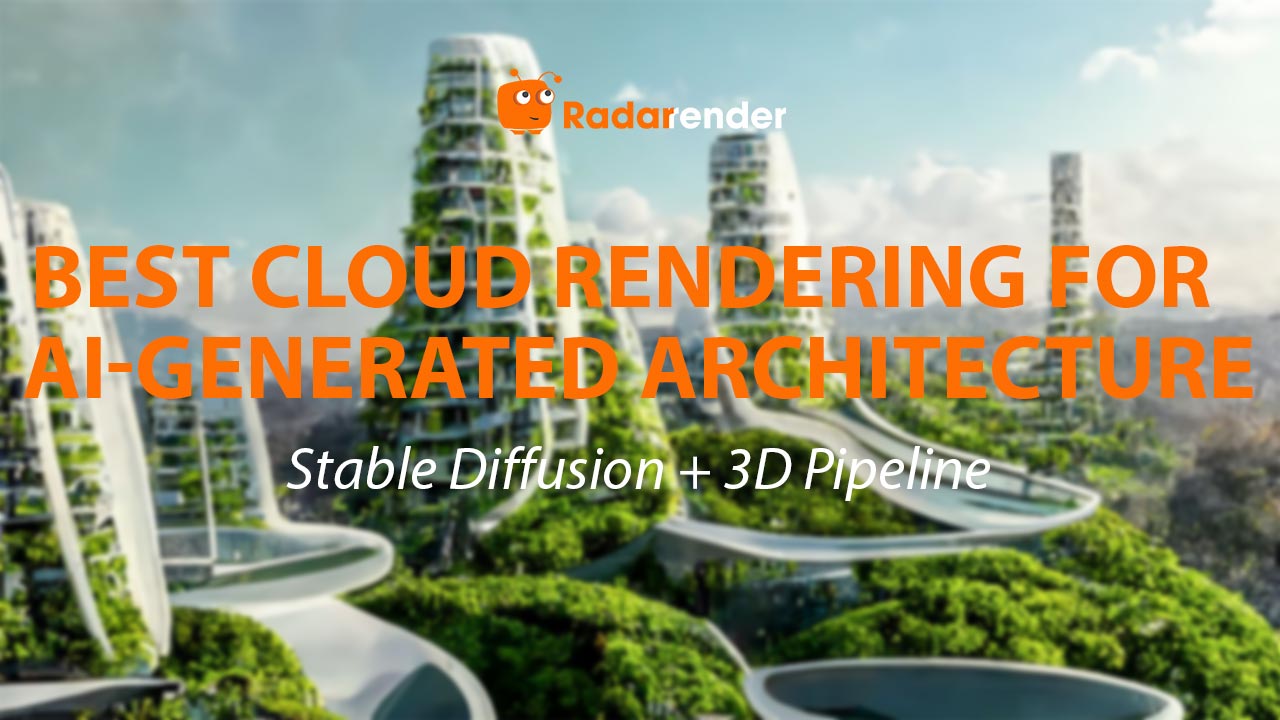
The emerging arch-viz workflow — AI concept generation followed by 3D rendering — runs entirely on a single cloud GPU. On iRender’s RTX 4090 (24 GB VRAM, ~$8.20/hr), you can run Stable Diffusion (via ComfyUI or Automatic1111) to generate concept images in 10–30 seconds each, then switch to Lumion, D5 Render, or Twinmotion for the final 3D render. Both workflows share the same GPU, same session, same billing. The RTX 4090’s 24 GB VRAM handles both SD’s model loading and 3D scene rendering without conflict. This is the pipeline studios are starting to adopt for competitions and early-stage design.
| Pipeline Stage | Tool | Time on RTX 4090 | Cost (est.) |
|---|---|---|---|
| AI concept generation | Stable Diffusion (ComfyUI) | ~10–30 sec/image | ~$0.02–0.07/image |
| AI style transfer / refinement | ControlNet + SD | ~20–60 sec/image | ~$0.05–0.14/image |
| 3D modeling | SketchUp / Rhino (on same server) | Manual — varies | ~$8.20/hr |
| Final 3D render | D5 Render / Lumion | ~3–15 min/image | ~$0.40–2.00/image |
| Full pipeline session | All of the above | ~2–4 hours total | ~$16–33 |
How Does the AI + 3D Pipeline Actually Work?
The workflow most studios are experimenting with: 1. Generate 20–50 AI concept images using Stable Diffusion with architecture-specific prompts. 2. Select the best 3–5 concepts and use them as design direction references. 3. Model the actual building in SketchUp or Rhino (on the same cloud server or locally). 4. Import the 3D model into D5 Render or Lumion. 5. Optionally use ControlNet to apply AI styling to the 3D render for a hybrid look. The whole process happens on one iRender session.
Important clarification: AI images alone aren’t suitable for client deliverables — they lack dimensional accuracy and constructability. The 3D rendering step is what makes the output usable for actual architecture projects.
Is This Pipeline Worth the Complexity?
For design competitions and early concept presentations — absolutely. Generating 50 concept variations in 10 minutes vs sketching them over days is a massive time advantage. For standard residential or commercial projects, it’s often overkill — you don’t need AI-generated concepts when the program is already defined by the client brief.
Standard billing: disconnect when done. AI + 3D sessions tend to run 2–4 hours. Overnight idle = ~$65.
See more: Run AI + 3D rendering on the same cloud RTX 4090 → View GPU servers & pricing
Frequently Asked Questions
- Can I run Stable Diffusion and Lumion on the same cloud server?
Yes. Both run on iRender’s RTX 4090 in the same session. Install ComfyUI or Automatic1111 for SD, and Lumion or D5 for 3D rendering. The 24 GB VRAM handles both — you switch between applications as needed. Same billing (~$8.20/hr) for the entire session.
2. How much does an AI + 3D rendering session cost?
A typical session generating 20–50 AI concepts + rendering 5–10 final 3D images takes 2–4 hours on iRender, costing $16–33 total. The AI generation part is nearly free (~$0.02–0.07/image). The 3D rendering is where most of the cost goes (~$0.40–2.00/image depending on renderer).
3. Are AI-generated images enough for architecture client deliverables?
No — not on their own. AI images lack dimensional accuracy and construction logic. They’re excellent for early concept exploration and design competitions, but client deliverables need 3D-rendered output from Lumion, D5, or V-Ray with actual building geometry. The AI → 3D pipeline combines the speed of AI with the accuracy of 3D.
Related post: Best Cloud Rendering for Architecture: SaaS vs IaaS Decision Framework