

Copernicus Computing Review 2026: Pricing, $25 Credit, Software and ISO
2026 review: published on 17 November 2026. Pricing, hardware, software and policy details were checked against Copernicus Computing’s official pages on 17 November 2026. We will update this page when the provider changes its offer.
Copernicus Computing is a CPU and GPU render farm that appears to be based in Toruń, Poland. It offers an automated farm with a web dashboard and cost estimates, plus GPU server and cluster rental and an optimisation tool called Copernicus Optimizer.
This is RadarRender’s first full review of Copernicus Computing, checked against its homepage on 17 November 2026. The homepage was last modified in August 2026, so the service is clearly active.
| Company name | Copernicus Computing |
| Website | https://copernicuscomputing.com/ |
| Country | Poland (Toruń region, not stated outright) |
| Service model | Automated render farm with web dashboard and app integration |
| Type of render farm | CPU and GPU |
| Main applications | 3ds Max, Maya, Blender, Cinema 4D, LightWave, Terragen, Rhino, Modo, SketchUp |
| Free trial | $25 starter credit, no credit card |
| Last checked | 17 November 2026 |
Copernicus Computing at a glance: our 2026 scores
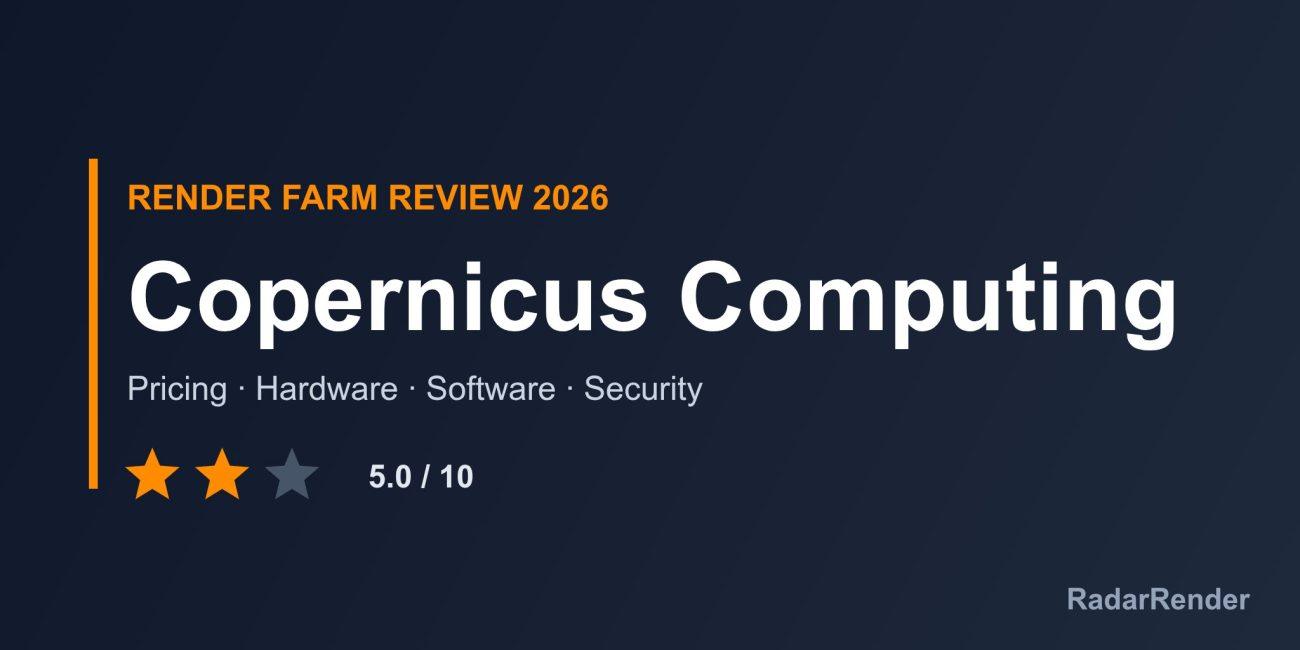
RadarRender scores every farm in our render farm directory on the same five axes with the same scale. Copernicus Computing averages 5.0 out of 10 (2 stars, Good).
| Axis | Score | Why |
|---|---|---|
| Hardware | 5 / 10 | About 20,000 CPU cores and 2,000,000 CUDA cores are claimed, but no CPU or GPU models are named. |
| Software | 5 / 10 | Nine host applications, with Redshift and Corona named and other plugins on a supported-apps page. |
| Price | 4 / 10 | Rates are published but conflict across the homepage ($0.04, $0.024 and $0.004 per GHz-hour). |
| Service | 6 / 10 | $25 starter credit and 24/7 support with web chat; no student offer. |
| Security | 5 / 10 | An ISO certificate page is linked, without the standard or scope. |
These are editorial scores based on published information, not lab results. We have not run a paid production test for this review, so any speed figures below are the provider’s own claims.
Workflow and supported software
Copernicus describes a plug-and-play integration with your 3D software, automatic rendering, a web dashboard for projects, real-time monitoring and a cost estimate before rendering. Login and sign-up are on an app subdomain, and there is a video tutorial.
Named applications are 3ds Max, Maya, Blender, Cinema 4D, LightWave, Terragen, Rhino, Modo and SketchUp, with Redshift and Corona among the renderers. The full list is on the supported-apps page, and unlisted applications can be requested through support.
Hardware and rendering speed
The homepage claims about 20,000 CPU cores and 2,000,000 CUDA cores, and its meta description mentions 9,100 GHz of processing power. GPU servers and a GPU cluster appear in the navigation, but no CPU or GPU models, RAM or VRAM are listed. The company also advertises a containerised data centre for sale, which suggests it runs its own hardware.
Pricing and actual costs
Pricing is the weakest part of the page because the numbers conflict:
- The meta description says USD 0.004 per GHz-hour.
- The lowest-price section says prices start at $0.04 per GHz-hour.
- The cloud render section says plans start from $0.024 per GHz and $0.004 per OBh (OctaneBench-hour).
Volume discounts reach up to 50%. A payment guide (PDF dated August 2026) is linked, but payment methods are not listed on the homepage. Use the built-in estimate on your own scene and confirm the rate with support before you buy credit.
Free trial and discounts
New accounts get a $25 starter credit without a credit card. No student discount is listed.
Customer support
Copernicus offers 24/7 support including weekends and holidays, by e-mail and real-time web chat, from a team it describes as rendering professionals.
Security and privacy
The site links to an ISO certificate page in several languages but does not say which ISO standard or scope it covers. Terms of use and a privacy policy are linked; NDA terms, encryption and data deletion are not described on the homepage.
Pros and cons
What works well
- $25 starter credit without a credit card.
- 24/7 support with live web chat.
- CPU and GPU capacity plus server and cluster rental.
- Cost estimate before rendering.
What to weigh before you commit
- Conflicting price figures on the same page.
- No CPU or GPU models published.
- ISO standard and scope not named.
- Legal entity and country not stated directly.
Who Copernicus Computing is for
Copernicus Computing suits archviz and product artists on 3ds Max, Cinema 4D, Rhino or SketchUp who want an automated farm with live chat support and free starter credit. Confirm the actual rate before a large job, since the homepage gives three different figures.
Compare Copernicus Computing with other farms in our render farm directory, read its directory profile, or estimate a job in the render farm cost calculator.
Frequently asked questions
How much does Copernicus Computing cost?
The homepage gives conflicting figures, from $0.004 to $0.04 per GHz-hour and $0.004 per OctaneBench-hour, with volume discounts up to 50%. Confirm the rate with support.
Does Copernicus Computing have a free trial?
Yes. New accounts get a $25 starter credit without a credit card.
Is Copernicus Computing ISO certified?
The site links to an ISO certificate page but does not name the standard or scope.
Does Copernicus offer 24/7 support?
Yes. It advertises 24/7 support including weekends, by e-mail and web chat.
Sources
- Copernicus Computing homepage (checked 17 November 2026)
No reader reviews yet. Have you rendered on this render farm? Be the first to rate it.