

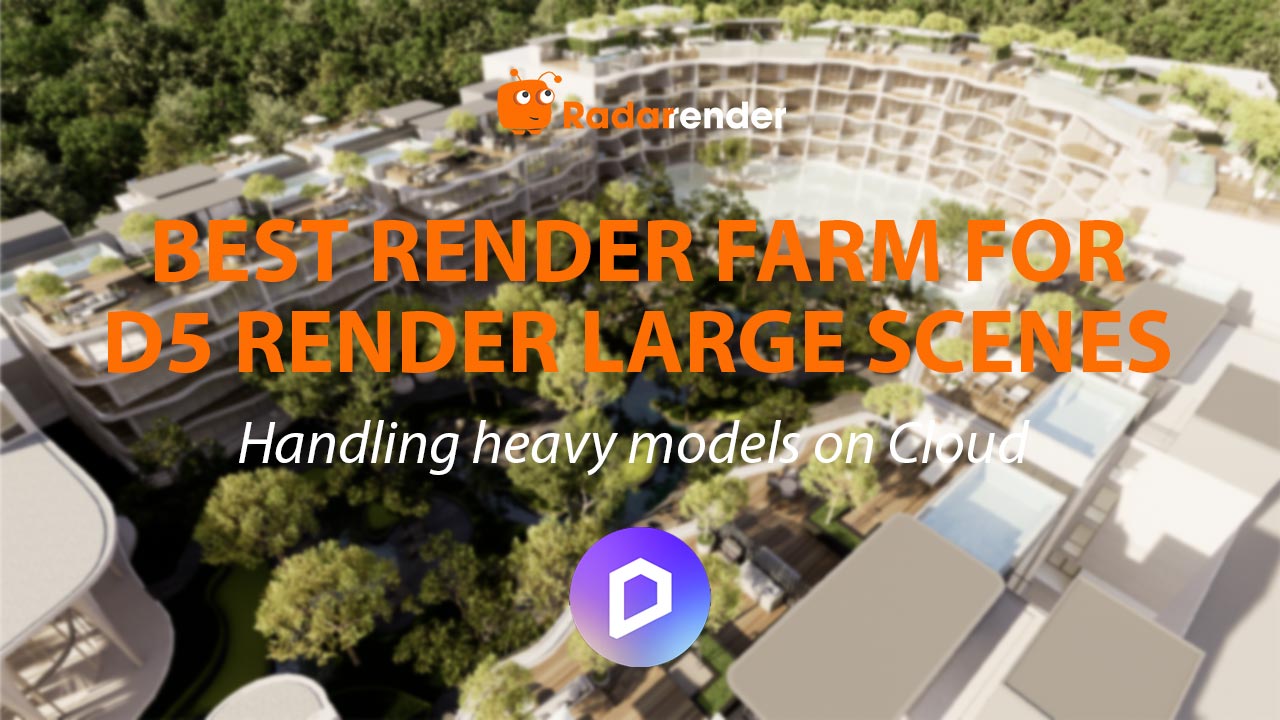
Best Render Farm for D5 Render Large Scenes: Handling Heavy Models on Cloud
The best render farm for large D5 Render scenes is iRender, offering RTX 4090 servers (24GB VRAM, 256GB system RAM) at ~$8.20/hour. D5 Render handles most architectural scenes efficiently, but large projects with 8,000–15,000+ objects (masterplans, resort complexes, urban blocks) push both VRAM and system RAM to their limits. On a local workstation with 16–32GB RAM and 8GB VRAM, these scenes slow down significantly or crash during rendering. iRender’s 256GB RAM ensures smooth scene loading, while the RTX 4090’s 24GB VRAM handles 4K rendering for scenes up to approximately 12,000 objects at maximum quality.
| D5 Scene Size | Objects | VRAM (4K) | System RAM | RTX 4090 Render |
| Small (< 500MB) | < 3,000 | 6–10GB | 8–16GB | 3–5 min |
| Medium (0.5–1.5GB) | 3,000–6,000 | 10–16GB | 16–32GB | 5–10 min |
| Large (1.5–3GB) | 6,000–10,000 | 16–22GB | 32–64GB | 8–18 min |
| Very Large (3GB+) | 10k–15k+ | 20–24GB ⚠️ | 64–128GB | 15–30 min |
Where Does D5 Render Hit Its Limits with Large Scenes?
D5 Render’s performance degrades noticeably above 8,000–10,000 objects — the real-time viewport becomes sluggish (dropping below 15fps), and the application’s scene management struggles with complex geometry. This is a known limitation compared to Lumion, which handles 15,000–20,000+ objects more reliably due to its more mature scene optimization engine.
On iRender’s RTX 4090, D5 Render renders large scenes without crashing (the 24GB VRAM and 256GB RAM handle the data), but the interactive experience (navigating the viewport, placing assets) slows down noticeably for very large projects. We recommend keeping D5 scenes under 10,000 objects for comfortable interactive use. For larger masterplans, consider splitting the project into zones and rendering each separately.
How Does D5 Large Scene Performance Compare to Lumion and Twinmotion?
For large scenes on the same RTX 4090 cloud server: Lumion handles the highest object counts (15,000–20,000+) with the most stable performance. D5 Render and Twinmotion both slow down above 8,000–10,000 objects, with D5 experiencing slightly more viewport lag than Twinmotion in our testing. However, D5 files remain significantly smaller than both competitors — a 10,000-object D5 scene is typically 2–3GB vs 5–8GB for Lumion and 3–5GB for Twinmotion, making upload to iRender 2–3× faster.
For architects working on masterplan-scale projects with 15,000+ objects, Lumion on iRender remains the most reliable choice despite its higher license cost ($1,998/year) and longer render times. For projects under 10,000 objects — which covers the majority of commercial and residential work — D5 delivers comparable quality at a fraction of the cost.
See more: Render large D5 scenes on 256GB RAM servers → View D5 Render server options on iRender
Frequently Asked Questions
- Can iRender’s RTX 4090 handle a D5 scene with 15,000+ objects at 4K?
The render itself will likely complete — the RTX 4090’s 24GB VRAM and iRender’s 256GB RAM can hold the data. However, the interactive viewport in D5 will be very sluggish (under 10fps), making it difficult to set up camera angles and adjust materials. We recommend preparing views locally on simpler proxy scenes, then loading the full scene on iRender only for final rendering to minimize billable time spent navigating a slow viewport.
2. Should I use D5 or Lumion for masterplan-scale projects on cloud?
Lumion for masterplans above 10,000 objects. Lumion’s scene optimization handles 15,000–20,000+ objects with stable viewport performance, while D5 slows significantly above 10,000. The trade-off: Lumion costs $1,998/year (vs D5 free) and renders 2–3× slower per image. For masterplans, the stability advantage is worth the cost premium. For projects under 10,000 objects, D5 is the better value.
3. How long does it take to upload a large D5 project to iRender?
D5 files are compact compared to competitors. A large 3GB D5 scene uploads in approximately 5–8 minutes on a 50 Mbps connection (vs 15–30 minutes for a comparable 6–8GB Lumion scene). Upload time is not billed if you transfer files before starting the server. For very large projects (5GB+), we recommend uploading overnight to avoid wasting billable session time.
Related post:
D5 Introduces an AI-Powered End-to-End Workflow for 3D Design