

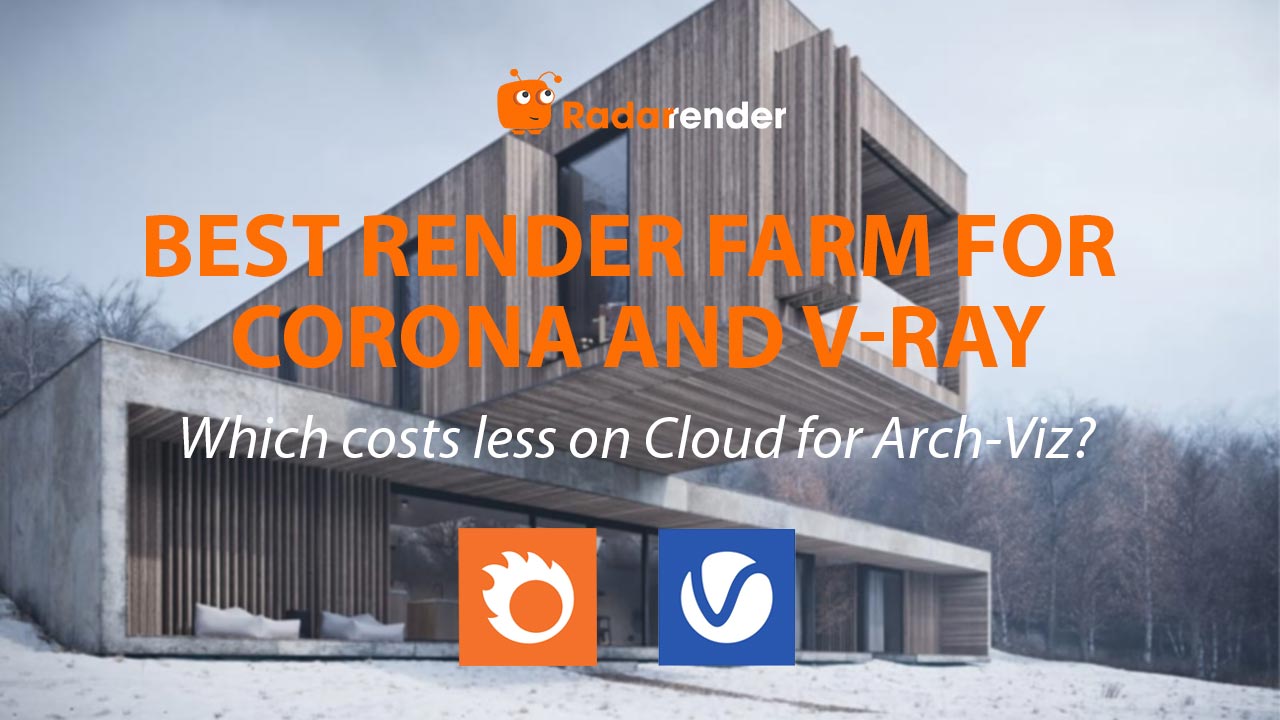
Best Render Farm for Corona vs V-Ray: Which Costs Less on Cloud for Arch-Viz?
V-Ray GPU is cheaper per image on IaaS cloud farms (iRender), but Corona matches V-Ray cost on SaaS farms (RebusFarm, GarageFarm) through parallel node distribution. On iRender’s single server, a 4K interior renders in 10–30 minutes with V-Ray GPU ($1.40–4.10) vs 30–75 minutes with Corona CPU ($4.10–10.25) — V-Ray wins by 2–3×. However, on RebusFarm, the same Corona image distributes across multiple CPU nodes, finishing in 5–15 minutes at approximately $1.50–4.50 — comparable to V-Ray. The real cost difference depends on which farm type you use, not which renderer. Both Corona and V-Ray produce excellent arch-viz output; the choice should be based on workflow preference, not cloud cost alone.
| Scenario | V-Ray GPU (RTX 4090) | Corona CPU (SaaS multi-node) |
| 4K Interior Still | 10–30 min / $1.40–4.10 | 5–15 min / $1.50–4.50 |
| 4K Exterior Still | 20–45 min / $2.70–6.15 | 8–20 min / $2.50–6.00 |
| 10-Image Batch | 2.5–7.5 hrs / $20–62 (iRender) | 20–45 min / $15–45 (SaaS) |
| 30-sec Animation (900 frames) | 5–12 hrs / $41–98 (iRender) | 1–3 hrs / $30–80 (SaaS) |
| Best Farm Type | iRender (interactive) or SaaS (batch) | SaaS only (RebusFarm, GarageFarm) |
Why Is V-Ray Cheaper on iRender but Corona Catches Up on SaaS?
The difference comes down to rendering architecture. V-Ray GPU uses the RTX 4090’s thousands of CUDA cores for massively parallel ray tracing on a single card — fast per image. Corona uses CPU cores only (no GPU acceleration), so on a single iRender server (64-core Threadripper Pro), it’s inherently slower than GPU rendering.
SaaS farms eliminate Corona’s disadvantage by distributing each image across multiple CPU nodes simultaneously. RebusFarm might assign 4–8 high-core-count machines to a single Corona frame, collectively applying 200–500+ CPU cores. This parallel approach makes Corona’s per-image time competitive with V-Ray GPU — and for batch rendering (10+ images), SaaS farms render multiple Corona images in parallel across dozens of nodes, often finishing faster than V-Ray on a single GPU.
Which Renderer Produces Better Arch-Viz Quality?
Both produce publication-quality architectural visualization — the differences are subtle and stylistic rather than objective. Corona is known for its simpler material setup, intuitive color mapping (LightMix), and a rendering “look” that many interior designers prefer for warm, natural lighting. V-Ray offers more control over every parameter, better caustics rendering, and GPU interactive preview for real-time lighting adjustments.
Many top arch-viz studios use Corona for interiors and V-Ray for exteriors. On cloud, this dual approach works well: use iRender for V-Ray GPU interactive work, then submit Corona batches to RebusFarm overnight. Both Chaos renderers share the same licensing ecosystem, making it easy to maintain both.
See more: Render V-Ray on cloud GPU or submit Corona to SaaS farms → [mkd_highlight background_color=”” color=”#FF8C00″]Render V-Ray on cloud GPU or submit Corona to SaaS farms → Compare cloud rendering options on iRender[/mkd_highlight]
Frequently Asked Questions
- Can I use both Corona and V-Ray on the same cloud render farm?
Yes. On iRender (IaaS), install both on the same server — switch between them in 3ds Max’s render settings. On SaaS farms (RebusFarm, GarageFarm), both Corona and V-Ray are supported with licensing included. A common studio workflow: use V-Ray GPU on iRender for daytime design iteration, then submit Corona final renders to RebusFarm overnight for batch processing.
2. Is Corona or V-Ray licensing cheaper for cloud rendering?
On SaaS farms, both are included in per-frame pricing — no separate license cost. On iRender (IaaS), both require separate licenses: V-Ray Solo ($350/year) and Corona Solo ($350/year) — identical pricing from Chaos. The difference: V-Ray GPU benefits from iRender’s RTX 4090 (faster renders = lower hourly cost), while Corona doesn’t use the GPU at all. For IaaS cost-effectiveness, V-Ray is the better investment.
3. Should I switch from Corona to V-Ray to save money on cloud?
Not necessarily. If you use SaaS farms (RebusFarm, GarageFarm), Corona’s cloud cost is comparable to V-Ray. Switching renderers means relearning materials, lighting workflows, and scene setup — a significant time investment. If you’re already productive with Corona, the better strategy is to use SaaS farms for batch rendering and keep Corona. Only consider switching if you need GPU interactive preview (V-Ray’s advantage) for design iteration on IaaS farms like iRender.
Related post:
Best Render Farm for V-Ray and 3ds Max Architecture: Studio-Grade Cloud Rendering