

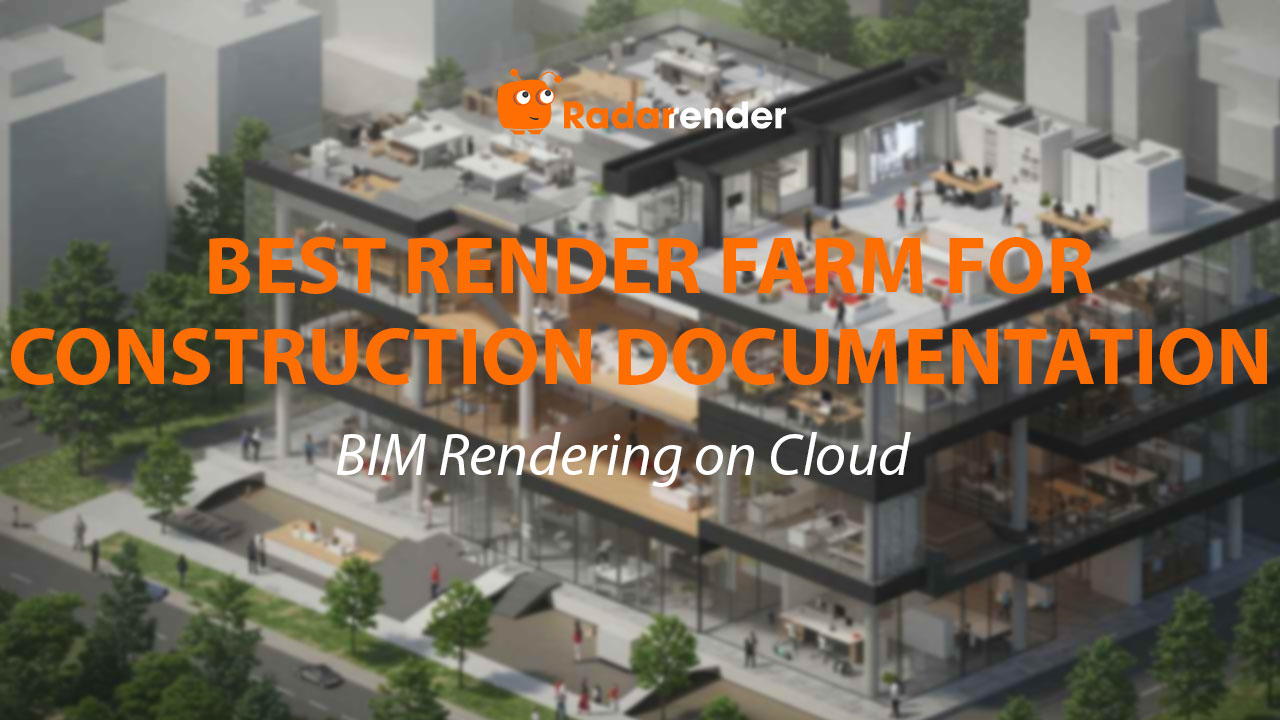
Best Render Farm for Construction Documentation: BIM Rendering on Cloud
Cloud rendering for construction documentation is different from marketing visualization — the goal is technical accuracy, not artistic beauty. Architects producing construction docs need shadow studies, material verification renders, daylighting analysis images, and context-accurate site views for planning submissions. On iRender’s RTX 4090 (24GB VRAM, 256GB RAM, ~$8.20/hour), Enscape inside Revit handles most doc-quality renders in 1–3 minutes per image ($0.15–0.40) — fast enough to generate 20+ shadow study views in a single 30-minute session ($4.10). For photorealistic material verification, V-Ray for Revit produces accurate representations in 10–25 minutes ($1.40–3.40). iRender’s 256GB RAM is the critical advantage — large BIM models with linked MEP and structural files consume 40–100GB RAM.
| Doc Deliverable | Best Tool | Time (RTX 4090) | Cost/Image | Quality Level |
|---|---|---|---|---|
| Shadow study (seasonal) | Enscape / Revit native | 1–2 min | $0.15–0.25 | Diagrammatic |
| Material verification | V-Ray for Revit | 10–25 min | $1.40–3.40 | Photorealistic |
| Planning submission context | Enscape / Twinmotion | 2–5 min | $0.30–0.70 | Presentation |
| Daylighting visualization | Enscape / V-Ray | 2–8 min | $0.30–1.10 | Analytical |
| Interior finish review | Enscape | 1–3 min | $0.15–0.40 | Design review |
How Is Construction Doc Rendering Different from Marketing Viz?
Construction documentation renders prioritize accuracy over aesthetics. Shadow studies need precise sun angles for specific dates and times — Enscape and V-Ray both calculate solar position from GPS coordinates and date/time inputs. Material verification renders must show exact colors and textures matching physical spec sheets — V-Ray’s color-managed rendering pipeline is essential here. Planning submission images need site context accuracy (existing buildings, streetscape, vegetation) rather than idealized environments.
The practical implication for cloud cost: doc renders are typically lower resolution (HD or 2K instead of 4K), require fewer render samples (accuracy over noise-free beauty), and are produced in larger batches per session. A 1-hour Enscape session on iRender ($8.20) can produce 20–40 shadow study images — far more cost-effective than marketing renders at 2–5 images per hour.
Which BIM Application Works Best for Cloud Doc Rendering?
Revit + Enscape is the most efficient combination: Enscape renders directly inside Revit with zero export, producing shadow studies and context views in 1–3 minutes. Switch to any Revit view, click render, repeat — no scene setup needed. Revit + V-Ray for material verification where physical accuracy matters (facade panel approvals, interior finish sign-offs). ArchiCAD + Twinmotion for ArchiCAD-based firms needing planning submission images with site context.
For batch shadow studies (same building, 12 sun positions across the year): set up 12 camera views in Revit, render all with Enscape’s “Render All Views” feature in approximately 15–30 minutes ($2.05–4.10) on iRender. This is the most common construction doc cloud workflow we see.
See more: Render BIM construction docs on cloud → Render BIM construction docs on cloud → View BIM-ready cloud servers on iRender
Frequently Asked Questions
- How much does a complete shadow study set cost on cloud?
A typical planning submission shadow study — 4 seasons × 3 times of day × 1 view = 12 images — costs approximately $1.80–3.00 with Enscape on iRender (12–24 minutes). For multiple views: 4 views × 12 sun positions = 48 images costs approximately $7.20–12.00 (48–96 minutes). This is dramatically cheaper than V-Ray ($16–82 for the same 48 images) because Enscape’s real-time engine produces diagrammatic shadow studies instantly.
2. Can I use Revit’s built-in rendering for construction docs on cloud?
Technically yes, but we don’t recommend it. Revit’s built-in renderer takes 15–30 minutes per image on an RTX 4090 — far slower than Enscape (1–3 minutes) for equivalent documentation quality. Revit’s renderer is based on older Autodesk technology that doesn’t leverage GPU acceleration effectively. For construction documentation, Enscape produces superior results at 5–10× faster speed on the same cloud server.
3. Do I need photorealistic quality for planning submissions?
Most planning authorities accept Enscape-quality images — clear, accurate representations of the proposed building in context. Photorealistic V-Ray renders are typically reserved for design review boards and community presentations where visual quality influences approval decisions. For standard planning submissions, Enscape at $0.30–0.70 per image is sufficient and significantly more cost-effective than V-Ray at $1.40–3.40.
Related post:
Best Render Farm for Interior Rendering: Photorealistic Interiors on Cloud