

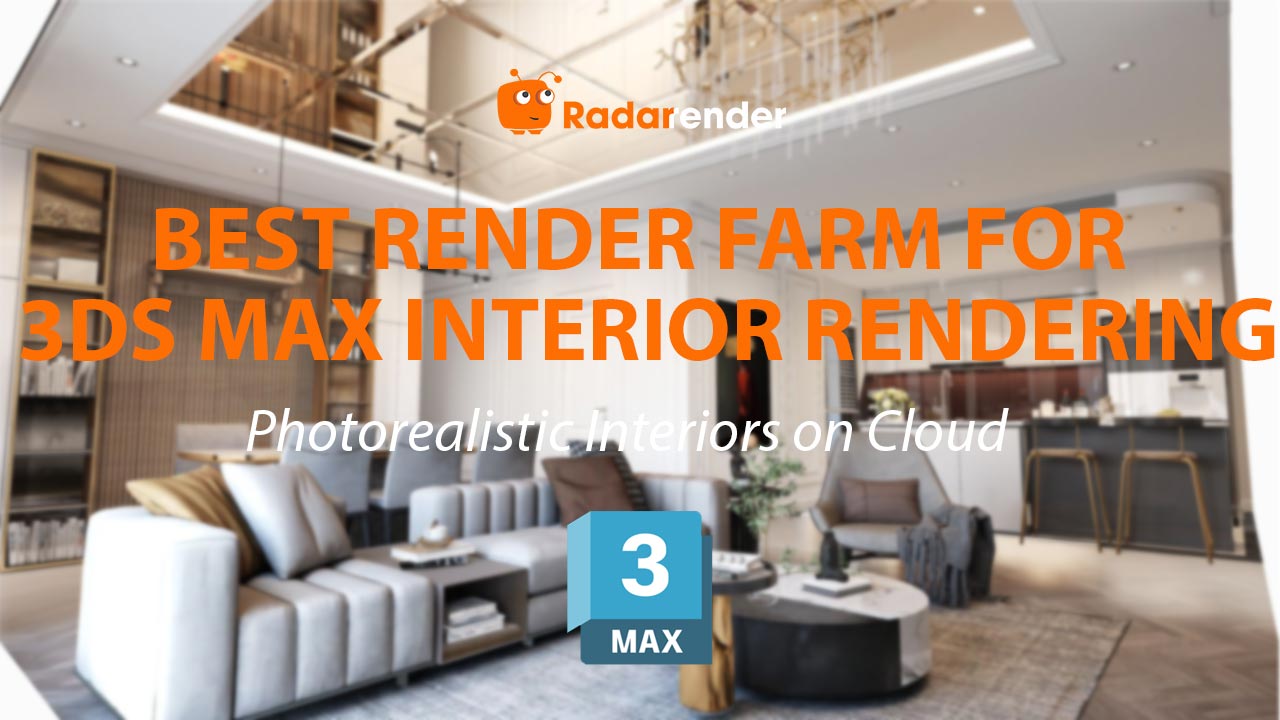
Best Render Farm for 3ds Max Interior Rendering: Photorealistic Interiors on Cloud
3ds Max interior scenes render 30–50% faster and cheaper on cloud than comparable exteriors because enclosed geometry contains light bounces and reduces ray tracing complexity. On iRender’s RTX 4090 (~$8.20/hour), a V-Ray GPU 4K interior renders in 8–25 minutes ($1.10–3.40). On RebusFarm (SaaS), a Corona 4K interior finishes in 5–15 minutes via multi-node distribution at approximately $1.50–4.50. The exception: bathrooms, kitchens, and lobbies with glass, mirrors, and polished surfaces take 40–80% longer due to caustics calculations. For photorealistic interior work, 3ds Max + V-Ray or Corona remains the industry standard — producing results that Enscape and Lumion cannot match in material fidelity and lighting accuracy.
| Room Type | V-Ray GPU (RTX 4090) | Corona CPU (SaaS parallel) | Cost Range |
| Bedroom / home office | 8–15 min | 4–10 min | $1.10–2.05 |
| Living room (open plan) | 12–25 min | 5–12 min | $1.65–3.40 |
| Kitchen (reflective surfaces) | 18–35 min | 7–16 min | $2.45–4.80 |
| Bathroom (caustics, glass, water) | 25–45 min | 10–22 min | $3.40–6.15 |
| Hotel lobby / restaurant | 20–40 min | 8–18 min | $2.70–5.50 |
| Retail showroom (spot lighting) | 15–30 min | 6–14 min | $2.05–4.10 |
How Can Interior Studios Cut Cloud Rendering Cost by 40%?
Two proven techniques: (1) NVIDIA AI Denoiser — render at 50–70% fewer samples and apply the denoiser on iRender’s RTX 4090. A bedroom that takes 15 minutes at full quality drops to 6–8 minutes with denoiser, saving approximately $0.95 per image. For 10-image batches, that’s $9.50 saved. (2) Disable caustics for rooms where glass and mirror reflections aren’t the hero element. Turning off caustics in V-Ray or Corona reduces bathroom render time by 30–40% with minimal visible impact at standard presentation viewing distances.
Combined, these two settings can reduce a 10-image interior presentation from approximately $22–55 to $12–30 — a 40–45% cost reduction on iRender with nearly identical visual quality.
V-Ray or Corona: Which Produces Better Interior Renders?
Both produce publication-quality interiors — the difference is stylistic. Corona is favored by many interior designers for its warmer, more natural default lighting behavior and simpler material setup. Corona’s LightMix feature lets you adjust individual light intensities after rendering — render once, then generate dozens of lighting variations without re-rendering. This is exceptionally cost-effective on cloud.
V-Ray offers more precise control over every render parameter — true caustics, anisotropic reflections, advanced subsurface scattering for marble and fabric. For magazine-quality close-ups of material details (kitchen countertops, bathroom tiles), V-Ray’s material system provides finer control. Both renderers produce identical quality since they share the same Chaos rendering core — the choice is primarily about workflow preference.
See more: Render 3ds Max interiors on cloud GPU → Render 3ds Max interiors on cloud GPU → View interior rendering servers on iRender
Frequently Asked Questions
- How much does a complete 3ds Max interior design package cost on cloud?
A typical interior package — 6 rooms × 3 camera angles × 4K = 18 images, plus one 30-second walkthrough — costs approximately $35–100 on iRender (V-Ray GPU, sequential, 4–10 hours) or $25–75 on RebusFarm (Corona/V-Ray, parallel, 30–75 minutes). With denoiser and caustics optimization, costs drop 30–40%. Most interior studios budget $50–120 per project for cloud rendering.
2. Is Corona LightMix worth using on cloud for interior projects?
Absolutely — it’s one of the most cost-effective features for cloud rendering. Render a single Corona image ($3–6 on iRender), then use LightMix to create 10–20 lighting variations (warm/cool, day/night, accent lights on/off) in seconds without re-rendering. On cloud at $8.20/hour, this saves approximately $30–60 compared to rendering each lighting variation separately. LightMix works fully on iRender’s remote desktop.
3. Should interior designers use Enscape or 3ds Max + V-Ray on cloud?
Different tools for different stages. Enscape renders in 2–5 minutes at $0.30–0.70 per image — ideal for design review and early client presentations (80–90% of visualization needs). 3ds Max + V-Ray takes 10–30 minutes at $1.40–4.10 — reserved for final portfolio shots, competition entries, and publication-quality hero images. Many studios use Enscape during design phase on iRender, then switch to 3ds Max + V-Ray for final output on the same server.
Related post:
Best Render Farm for Corona and 3ds Max: Fastest CPU Farm for Architecture